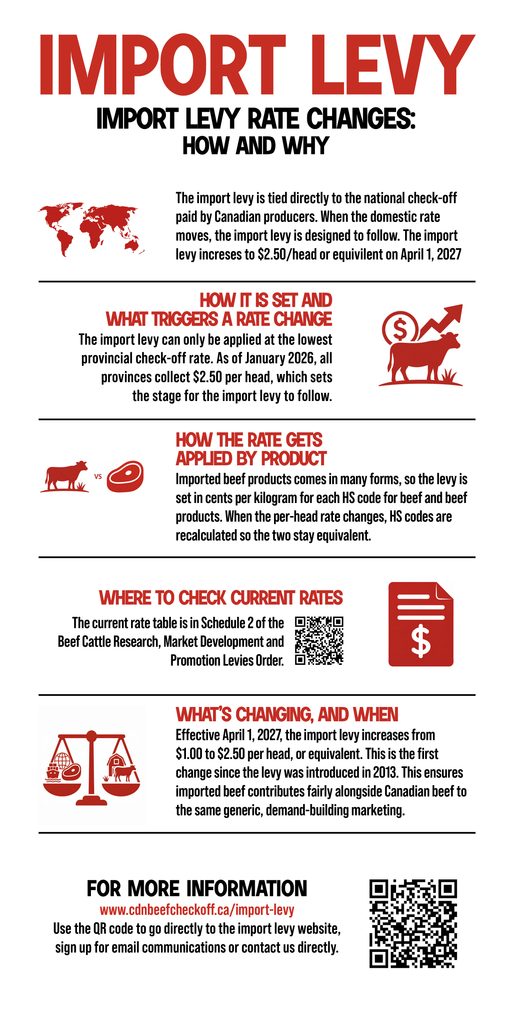
Levy Rate Changes: How and Why
The import levy isn’t a static number set once and forgotten. It’s tied directly to the national check-off paid by Canadian producers, which means when the domestic rate moves, the import levy is designed to follow. Understanding how that adjustment works, and what’s changing on April 1, 2027, helps importers know what to expect and when.
HOW IT IS SET AND WHAT TRIGGERS A RATE CHANGE
The import levy can only be applied at the lowest provincial check-off rate in Canada. For years, the check-off was $1 per head, until the industry saw a need for increased investment, and provinces began adjusting their rates in 2018 to collect a $2.50 per head check-off.
As of January 2026, all provinces are now collecting the $2.50 per head check-off. This sets the stage for the import levy to follow suit, improving fairness and alignment between Canadian beef producers and importers. Aligning the import levy with the national check-off rate helps ensure imported beef contributes equitably to demand-building activities in the Canadian marketplace.
The increase was formally announced to importers on May 11, 2026.
HOW THE RATE GETS APPLIED BY PRODUCT
Because imported products arrive in many different forms like fresh or frozen, carcasses, cuts, offal, or processed beef, the levy can’t simply be charged as a flat per-head fee at the border. Instead, the Beef Cattle Research, Market Development and Promotion Levies Order sets out a formula in Schedule 2 that assigns a levy value, in cents per kilogram, to each HS code covering beef, beef cattle and beef products.
Each month, invoices are generated for any individual or business importing beef cattle, beef or beef products into Canada in the previous month. The invoices are generated by Agriculture and Agri-Food Canada (AAFC), based on information received from Canada Border Services Agency (CBSA), and the collection of the import levy is up to the Canadian Beef Check-Off Agency. The information on the invoices is generated based on the importer’s business identification number, HS codes of imported products, quantity of imported product, and levy rate.
When the per-head rate changes, every value in the HS code schedule needs to be recalculated and updated so the per-kilogram rate stays equivalent to the new per-head amount. This is the technical work behind a rate change: it isn’t just one number changing, it’s dozens of HS code values across fresh, frozen, and processed beef categories all being recalibrated together.
WHERE TO CHECK CURRENT RATES
Importers can find the current Schedule 2 rate table through the Beef Cattle Research, Market Development and Promotion Levies Order,
The Agency recommends verifying the code and rate for a specific product before remitting.
WHAT’S CHANGING, AND WHEN
Effective April 1, 2027, the import levy is increasing from $1.00 to $2.50 per head or weight equivalent on beef and beef products, the first change since the levy was introduced in 2013. This brings the import levy into alignment with the $2.50 national check-off now paid by producers in every province, ensuring imported beef contributes fairly alongside Canadian beef to the same generic, demand-building marketing.
The expected impact on consumer prices is minimal, estimated at less than one cent per kilogram and fractions of a cent per serving.
Have questions about the upcoming rate change?