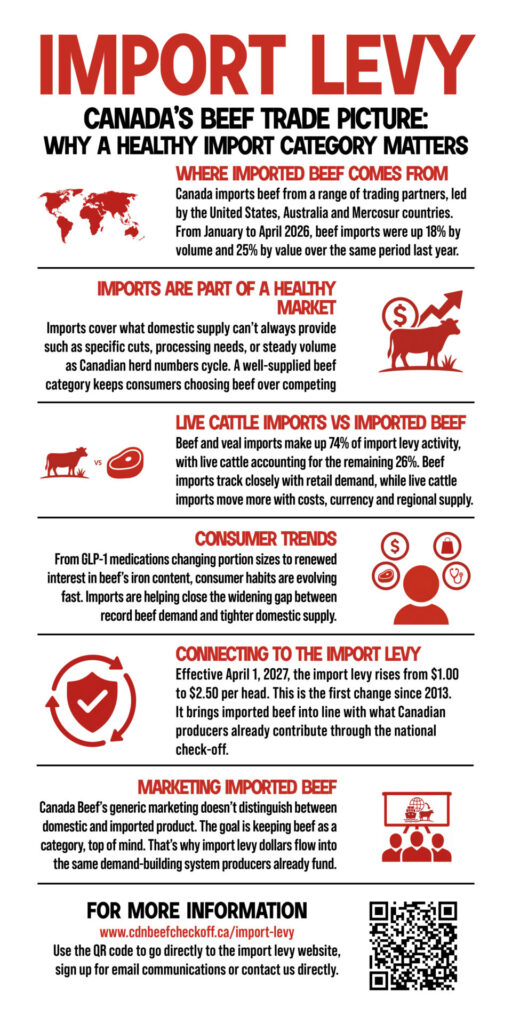
Canada’s Beef Trade Picture: Why A Healthy Import Category Matters
Canada’s beef market doesn’t operate in isolation. Alongside the cattle raised and beef produced here at home, imported beef, beef cattle and beef products make their way onto Canadian plates every year and that imported volume plays a real role in keeping the overall beef category strong. Understanding where that beef comes from, and why it matters, helps explain the purpose behind the import levy itself.
WHERE IMPORTED BEEF COMES FROM
Canada imports beef and beef products from a number of trading partners, including the United States, Australia, and other major beef-exporting countries. Most of what enters Canada is finished beef and beef products rather than live cattle, used across retail, foodservice and processing.
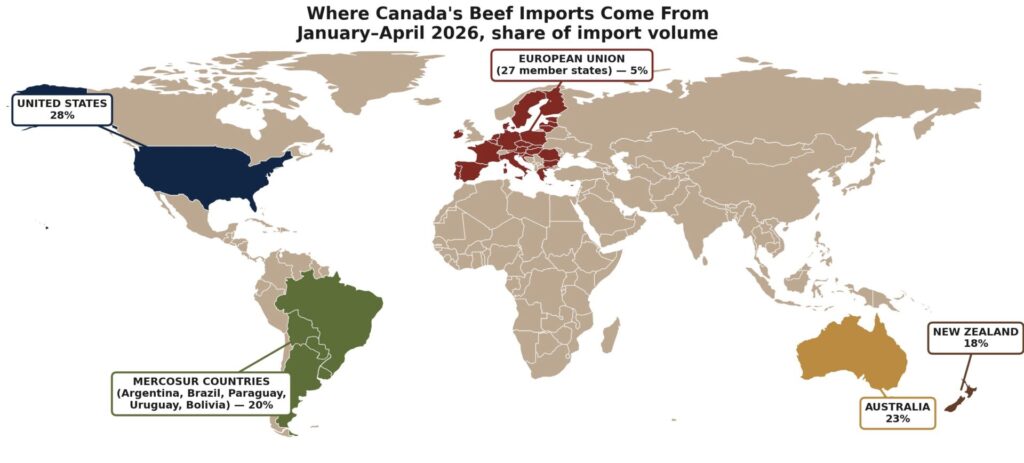
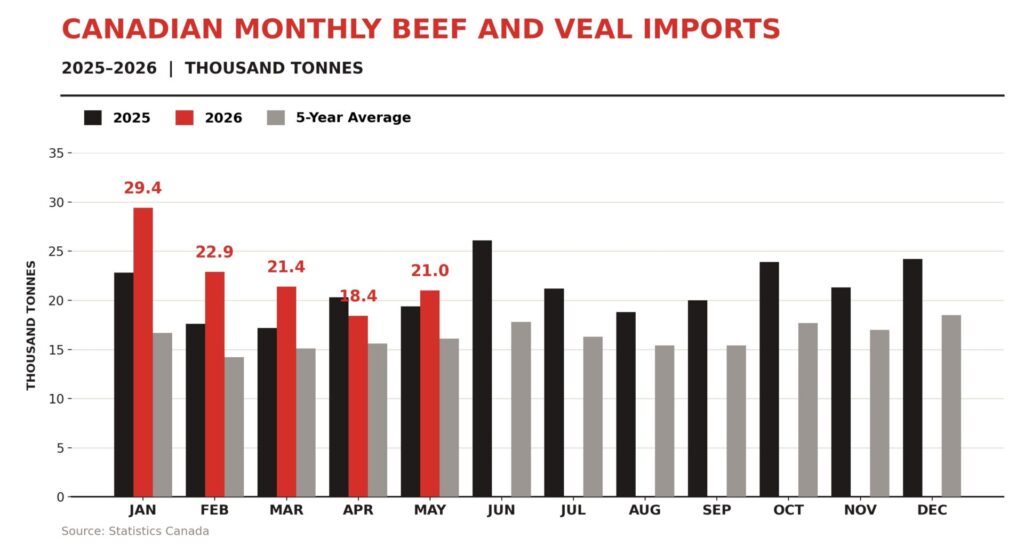
From January to April 2026, Canada’s beef imports increased 18% by volume and 25% by value compared with the same period in 2025. The United States remained Canada’s largest supplier, providing 28% of imported beef, followed by Australia at 23%, Mercosur countries at 20%, New Zealand at 18% and the European Union at 5%. By the end of May, combined imports of beef, veal and live-cattle equivalents had reached 153.7 million kilograms.
IMPORTS ARE PART OF A HEALTHY MARKET
Imports fill gaps that domestic supply alone can’t always cover. Whether that’s specific cuts in high demand, product for processing, or simply keeping supply steady when Canadian herd numbers cycle up and down. A stable, well-supplied beef category benefits everyone in the value chain. When beef is consistently available and reasonably priced, consumers keep choosing it over competing proteins.
That’s the connection point to generic beef marketing. Whether beef reaches a consumer’s plate as a Canadian product or an imported one, every purchase reflects consumer confidence in beef as a category. Keeping that category strong protects demand for all beef sold in Canada, domestic and imported alike.
LIVE CATTLE IMPORTS vs IMPORTED BEEF
While the import levy also applies to imported beef cattle, the majority of import levy activity comes from beef and beef products rather than live animals. Live cattle imports remain a much smaller part of the picture. Live cattle imports account for 26% of the import levy, whereas beef and veal imports account for 74%.
One trend that is worth noting, is that while beef imports have increased steadily over the past few years, imports of live cattle have fluctuated, dropping slightly in 2022 and 2023, before rebounding in 2024 and 2025.
Taken together, the figures show Canada increasingly drawing on imported supply in both forms. Beef imports respond more directly to immediate consumer and retail demands. Like imported beef, cattle imports are sensitive to costs, inputs, currency exchange and regional cattle availability.
CONSUMER TRENDS
Consumer behaviour around beef doesn’t stand still. Emerging factors, from the growing use of GLP-1 medications affecting appetite and portion sizes, to renewed public attention on iron deficiency and beef’s role in addressing it, to a rising interest in direct-to-consumer beef sales, are all reshaping how Canadians think about and buy beef and continue to drive demand.
Tighter domestic supply, combined with the strongest consumer beef demand in decades, has widened the gap between what Canada produces and what the market wants to buy. Imports help close that gap and keep consumers purchasing beef, particularly for lean trim used in ground beef, a category domestic production alone doesn’t fully meet. In 2025, Canada’s beef imports reached their highest share of domestic consumption since the early 2000s.
For consumers, that means imported beef plays a real role in keeping retail beef available and helping moderate how quickly tight domestic supply translates into higher prices. As retail beef prices sit near record highs, there’s early evidence consumers are managing cost by shifting which cuts they buy rather than buying less beef overall. Categories like ground beef, briskets and short plates, often more budget-friendly than middle cuts, have seen growing consumer interest.
CONNECTING THE PICTURE TO THE IMPORT LEVY
This is also the backdrop for a change coming to the import levy itself. Effective April 1, 2027, the import levy will increase from $1.00 to $2.50 per head, or equivalent. This is the first change since the levy was introduced in 2013.
The purpose of the increase is fairness and alignment. Canadian producers currently contribute $2.50 per head through the national check-off to fund demand-building work for beef in Canada. Because imported beef also benefits from a strong, well-promoted beef category here, this adjustment brings the import levy into line with what producers already contribute.
This isn’t about discouraging imports or creating a trade barrier. It’s about making sure that as imported beef takes its place in Canada’s overall beef supply, it contributes fairly to the generic marketing work that helps keep beef competitive across the board. The expected impact on consumer prices is minimal, estimated at less than one cent per kilogram and fractions of a cent per serving.
MARKETING IMPORTED BEEF From a marketing perspective, Canada Beef doesn’t distinguish between domestic and imported beef when it comes to generic, unbranded programming. The goal of that programming is to keep beef, broadly, top of mind for Canadian consumers. Which is exactly why import levy dollars are directed into that same generic marketing system rather than country-specific promotion.